Why You Feel Behind in October: A 4-Question Goal Audit for the Last 90 Days
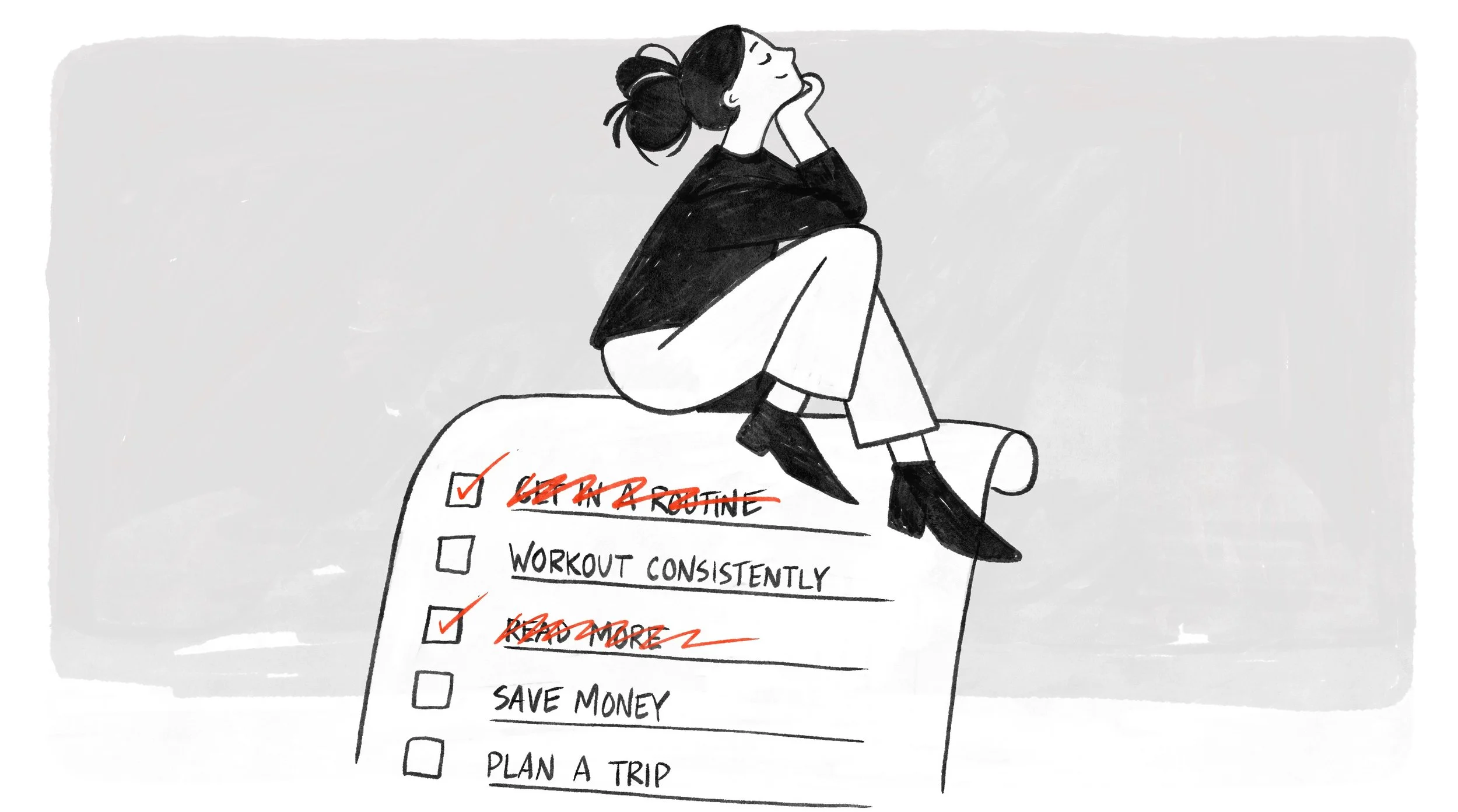
The Candle, the List, and the Math You Didn't Ask For
October is such a good month. The air finally does the thing. There's a candle going that smells vaguely like a bakery. There are pumpkins outside grocery stores. Everyone is slightly cozier and slightly nicer.
And then, usually on a Sunday evening, a very unwelcome thought arrives fully formed. There are three months left in the year.
We don't even mean to do the math. It just happens. We think about the January list. The thing we were going to launch. The savings account, the book, the trip, the friendships we were going to be better at. The certification. The apartment we were going to make look like an adult lives there.
And the feeling that shows up isn't panic exactly. It's quieter and worse. It's a kind of low-grade dread that says I've spent nine months being busy and I'm not sure any of it counted.
If that landed a little too accurately, come sit down. We're not doing the guilt thing here.
Let's sit with it for a second instead of rushing past it, because most advice about this moment gets it exactly wrong. The internet's answer to October is "Q4 sprint" energy. Ninety days to finish strong, one last push, don't waste the runway. And every time I see it I want to lie down.
Here's what's actually going on. We don't have a productivity problem. We have a list that was never fully ours.
"Behind" Compared to What, Exactly?
Try this. Say the sentence out loud. I'm behind.
Now finish it honestly. Behind what? Behind who?
There's no finish line here. There's no cohort of thirty-two-year-olds who all got the same starting gun and the same course. The feeling of being behind requires a schedule, and when we go looking for ours, we usually find it was assembled out of other people's stuff.
• A goal we absorbed from someone's post in February, when they made it look easy.
• A goal our family has had opinions about since we were twenty-four.
• A goal that made sense for the version of us who existed in January and doesn't quite fit the one reading this.
• A goal that's genuinely ours but has never once been given actual time on the calendar, only guilt on the conscience.
That last one is the sneakiest. A goal we've never scheduled but think about constantly isn't a goal. It's a tax. We're paying interest on something we never bought.
And none of this makes us people who let things slide. It makes us people who have been paying close attention to what everyone else wanted, which is a kind of care. It's just been pointed in the wrong direction for a while.
So before anyone talks about a strong finish, the honest work of October is subtraction. Not how do I do more in ninety days. How much of this was ever mine to carry?
Clarity isn't doing more. It's realizing half of it was never yours.
Why October Is the Right Month for This
There's a reason this lands better now than it would in July.
Summer resists reflection. It's loose and warm and there's always somewhere to be, and thinking hard about direction while sweating in a car feels borderline hostile. But fall does something to us. The days get shorter, we're inside more, the pace comes down a little. We nest. We tidy. We start putting things in order without being asked to.
That instinct, the one that has us reorganizing a closet on a Saturday we'd planned to do nothing, is worth pointing somewhere useful.
Because here's the thing about doing this in October rather than December. We'd be doing it depleted. After the holidays, with the New Year's noise everywhere, everything gets evaluated through exhaustion and comparison, and we either write a wildly unrealistic January list or feel too flat to write one at all. We've all done both.
October you is calmer. October you has the whole quarter still ahead. October you can put things down gently instead of dropping them.
I like October you. Let's use her while she's here.
The 20-Minute Audit
Make something warm to drink first. Truly. This is a kind thing you're doing for yourself, not a performance review, and it should feel at least a little bit like a Sunday.
Then get one piece of paper. Not a new notebook, you don't need a fresh notebook, that's a procrastination costume and we both know it. Paper, back of an envelope, notes app, fine.
Write down every goal, project, and vague ambition currently taking up room in your head. Not just the official ones. The half-goals count. Be better about calling my mom. Do something with the guest room. Figure out the career thing. Get them out where you can look at them. Most people land somewhere between eight and twenty, and just seeing the number tends to explain a lot about why you've been tired.
Then run each one through four questions. Take them slowly. Nobody is grading this and there's no wrong answer, only a more honest one.
Question 1: Whose is this?
Ask it plainly. Is this mine, or did I inherit it?
Not "is it a good goal." Plenty of these are excellent goals. For someone.
Trace where it came from. Did you want this before you saw someone else doing it? Would you have arrived at it on your own, in a quiet room, with no internet? Or did it get installed sometime around a scroll session in February?
You'll know almost immediately. The inherited ones have a particular texture, there's a "should" attached, and a faint image of someone else doing it well. The real ones feel more like a pull than a push.
Mark the inherited ones. Don't do anything with them yet. Just mark them.
And go easy on yourself about how many there are. A goal can be genuinely beautiful and still belong to somebody else.
Question 2: Would I still want this if no one ever knew I did it?
Okay, this one stings a little. Ask it anyway, it's the most useful of the four.
Imagine you achieve the thing and you're never allowed to mention it. No post, no telling anyone, nothing changes in how anybody sees you. Just the private experience of having done it.
Some goals get better under that condition. The reading, the walking, the money quietly building, the skill you actually enjoy, take away the audience and they're still lovely. Those are yours.
Others deflate entirely, because the point was never the thing. The point was being seen as a person who does the thing. Which, honestly, is such a human wish that I refuse to be snobby about it. I want to be perceived as impressive too, most days before noon. But it does mean the goal will never satisfy you, because the desire underneath it is to feel like enough, and no certification has ever managed that.
Mark the ones that deflate. Gently. You're not in trouble.
Question 3: Is this a season or a problem?
For the goals that are genuinely yours but have gone nowhere, ask this before you conclude anything about your character.
A season is heavy but moving. It's the year you moved twice, or the stretch where work was genuinely relentless, or the months you spent helping someone you love through something hard. Seasons pass on their own if you're patient with them. Nothing is wrong. You are simply carrying a lot right now, and the goal is not dead, it's parked.
A problem just sits there, unchanged, no matter how hard you push. Same conversation, same stuck point, year after year, regardless of how much time or energy you throw at it.
Seasons need patience. Problems need a different approach, or an honest goodbye. Both are allowed.
The relief here is enormous, because most of what we call "failing at a goal" is actually just being in a season and interpreting it as a personality defect. If you're in a season, the goal doesn't come off the list. It gets a note that says not now, and that's a real answer.
Question 4: What's the smallest true version of this?
Now take the ones that survived and shrink them.
Not the five-year version. The version you could start this week and actually keep. This isn't lowering your standards; it's finding the entrance.
• "Get back in shape" → a fifteen-minute walk after work, most days.
• "Fix my finances" → look at the balance once a week without flinching.
• "Be better with friends" → one text back before I overthink it.
• "Write the thing" → two sentences on Sunday mornings, badly.
• "Do something with the guest room" → clear the chair. Just the chair.
If the smallest true version still feels heavy, it's a sign the goal belongs in the inherited pile after all. Real ones get lighter when you shrink them. Borrowed ones stay heavy at every size, because the weight was never the workload.
Now the Actual Crossing Off
Here's where you look at your marks.
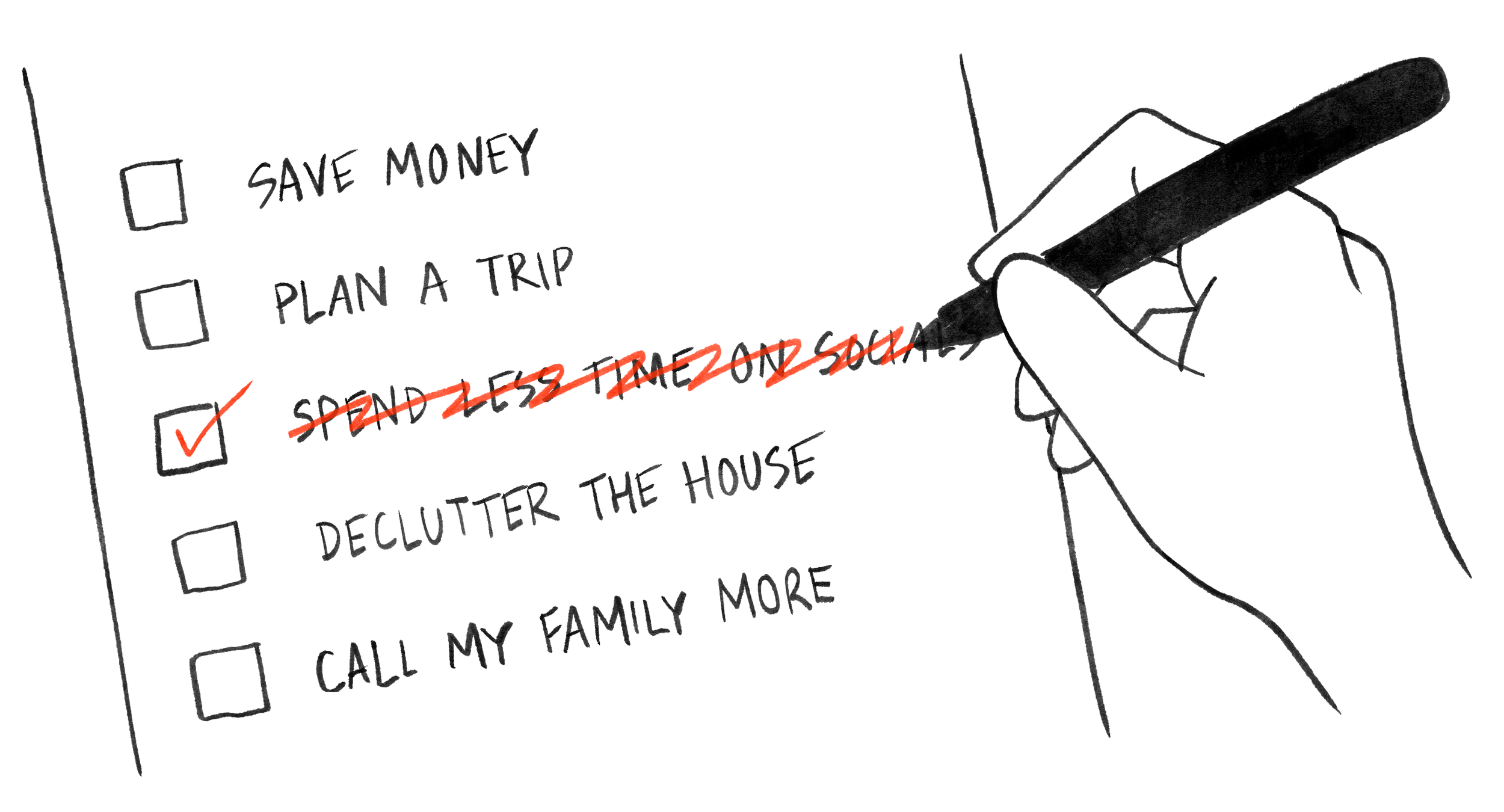
Take everything flagged as inherited, everything that deflated without an audience, and everything that's been a problem for three years running, and cross it off.
Physically. Pen through it. Not "revisit later," not "move to next quarter." Off.
I know. I know that feels wrong. We're trained to believe abandoning a goal is a small moral failure, and the internet has convinced an entire generation that quitting anything is a character issue. It isn't. Putting down a goal that was never yours is not quitting. It's aim. You didn't lose anything. You freed up the attention you'd been spending on it, which was substantial and mostly spent on guilt rather than progress.
Count that as progress. I mean that literally, write it down. In October I crossed off four things I was never going to do and didn't want to. That's a real accomplishment and it belongs in your year-end reflection right next to whatever you finished.
The first time I did this properly, I crossed off learning piano.
I'd actually started, which is the part that made it so hard to let go of. I hired an instructor. I showed up for three weeks, three real lessons, and then I quit. And I never officially decided anything after that, so the goal just stayed. It moved onto the next year's list, and the year after that, quietly collecting interest. Every time I walked past the keyboard I felt that small, specific sink, the one that says you started something and you couldn't even keep it three weeks.
So when I finally sat down and asked whose goal it was, the answer came embarrassingly fast. I'd absorbed it from someone I admired who plays beautifully, the kind of person who sits down at a piano at a party and everyone turns around. I wanted to be that. I did not want to practice scales on a Tuesday night after work. Those turned out to be two completely different wishes, and I'd spent years feeling like a quitter over the wrong one.
So I crossed it off. Out loud, which felt very dramatic for a Tuesday.
And here's the part that got me. What I actually wanted was music in my life, and I already had that. I put something on the second I get home, every single day, and I'd never counted it once, because it wasn't impressive and nobody was going to turn around and look at me for it.
The thing I loved wasn't even on the list.
Nothing bad happened. Nobody noticed. Three weeks of lessons turned out to be plenty of information.
What to Do With the Two or Three That Stay
You'll probably end up with two or three.
That's not too few. That's what a real life supports, and I'd rather see you keep two things all the way to January than admire fourteen from a distance.
For each one, take the smallest true version from Question 4 and give it one anchor, meaning an existing part of your day it can attach to. After I close my laptop, fifteen-minute walk. Sunday coffee, two sentences. That's the entire plan for the rest of the year.
Then decide the bad-day version, because November has short days and December has everything else. Walk to the corner. One sentence. Look at the balance for eight seconds. Small enough that a hard week can't take it from you.
And here's the part I care about most. Connect each one to who you're becoming, not to a number. You're not walking to hit a step goal. You're becoming a person who goes outside when her head gets loud. You're not writing two sentences to finish a book by March. You're becoming a person who writes. Each small kept thing is a vote for her, and votes are cumulative in a way that outcomes aren't.
Ninety days of two or three small things you actually keep will change more than ninety days of a twelve-item list you abandon by the eleventh. And if one of them slips in November, it slips. You pick it up the next day. That's the whole arrangement.
A Gentle Gut-Check for the Rest of the Year
Three things to notice between now and the end of December.
Notice what you reach for when you're tired. Not what you plan when you're fresh, what you actually do at 8pm on a Wednesday. There's real information in there about what you want versus what you think you want.
Notice which crossed-off goal you miss. If one of them keeps tapping you on the shoulder in November, that's useful. Put it back. This audit isn't a permanent ruling; it's a way to hear yourself over the noise.
Notice how it feels to have a shorter list. Some people feel immediate relief. Some feel briefly anxious, like they're getting away with something, because a long list has been quietly functioning as proof of ambition. If that's you, be patient with yourself for a week or two. A long list isn't ambition. It's often just an unexamined inbox, and the discomfort of a short one fades faster than you'd think.
Remember,
I'm not going to tell you to finish the year strong. I don't fully know what that means, and I suspect it mostly means "tired."
Here's the honest version instead. We have about ninety days. That's plenty of time for two or three small things we genuinely care about, and nowhere near enough for the fourteen we've been carrying. The math only feels cruel while the list is long.
So cross things off. Keep the few that are actually yours. Make them small enough to survive a dark Tuesday in November, and then just... keep them, unremarkably, while the year winds down around you.
And if you get to December with only two small things to show for the quarter, we'd call that a good year. Not a consolation prize, an actual good year. We mean it.
Come January, you won't be the person writing a brand-new list. You'll be the person who's already been quietly doing two things since October.
That's a very different starting line. And it's yours, which was always the point.
Take your time with the paper. We're right here.